KAMPALA – UGANDA
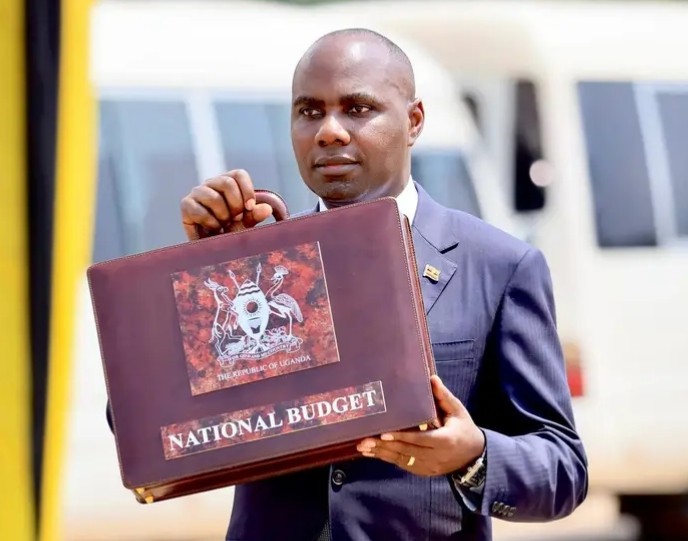
The Government of Uganda has unveiled its national budget for the Financial Year 2026/27, setting out an ambitious roadmap aimed at accelerating economic transformation, creating jobs, and positioning the country towards becoming a $500 billion economy.
Presenting the budget at Kololo Independence Grounds on Thursday, Minister of Finance, Planning and Economic Development, Henry Musasizi, announced that the new financial year’s budget will focus on the theme: “Full Monetisation of Uganda’s Economy through Commercial Agriculture, Industrialisation, Expanding and Broadening Services, Digital Transformation and Market Access.”

The minister said the budget marks the beginning of implementing the new National Resistance Movement (NRM) manifesto and the second year of the Fourth National Development Plan (NDP IV), which seeks to deliver Uganda’s Tenfold Growth Strategy. He noted that the government’s primary objective is to ensure economic growth translates into increased household incomes, productive employment, enterprise development, and improved living standards for all Ugandans.
Economy Registers Strong Growth
According to the budget speech, Uganda’s economy remains resilient despite global economic uncertainties. Economic growth for FY2025/26 is estimated at 6.4 percent, up from 6.3 percent the previous year, with the economy expected to reach approximately USD 69.3 billion (Shs 250.4 trillion) by the end of June 2026. GDP per capita is projected to rise to USD 1,420, equivalent to about Shs 5.1 million per person.
Government projects growth to surge to 10.2 percent in FY2026/27, driven largely by the commencement of commercial oil production later this year. The minister said this would mark Uganda’s first return to double-digit growth since the economic reforms of the 1990s.
Inflation remains stable at 3.8 percent, while foreign direct investment has reached USD 3.2 billion, reflecting growing investor confidence in the country. Tourism receipts have also rebounded strongly, reaching USD 1.86 billion in 2025, surpassing pre-pandemic levels.
Exports, Remittances and Revenue Rise
Uganda’s export earnings have recorded remarkable growth, reaching USD 18.04 billion in the twelve months ending March 2026, compared to USD 5.93 billion in 2022. Coffee exports alone earned USD 2.46 billion, reinforcing the sector’s importance to the economy.
The country also registered a balance of payments surplus of USD 2.47 billion, the highest in 15 years, while remittances from Ugandans abroad increased to USD 2.8 billion. Domestic revenue collections are projected to rise from Shs 35.7 trillion this financial year to Shs 45.6 trillion in FY2026/27.
Wealth Creation Remains a Priority
Government highlighted major investments in wealth creation initiatives, including the Parish Development Model (PDM), which has received Shs 4.4 trillion and reached all 10,589 parishes nationwide. By the end of June, more than four million beneficiaries are expected to have accessed PDM funds.
Additional support has been channelled through programmes such as Emyooga, the Agricultural Credit Facility, the Uganda Development Bank, women entrepreneurship funds, youth livelihood programmes, and a revolving fund for creatives. Government has allocated an additional Shs 2.49 trillion to wealth creation programmes in the new financial year.
Major Investments in Agriculture, Tourism and Oil
The budget prioritises investment in four strategic sectors collectively known as ATMS—Agro-Industrialisation, Tourism Development, Mineral-Based Industrial Development, and Science, Technology and Innovation.
Agriculture has received its highest-ever allocation of Shs 2.26 trillion, with funding earmarked for irrigation, agricultural research, extension services, quality inputs, value addition and market access.
Tourism will receive Shs 567.32 billion to support destination marketing, infrastructure development, conservation, and hospitality improvement. Uganda’s tourism sector has gained international recognition, winning several global awards and attracting increasing visitor numbers.
Government also announced continued progress toward first oil production, with construction of the East African Crude Oil Pipeline and other petroleum infrastructure nearing completion. A total of Shs 473.51 billion has been allocated to mineral development, oil and gas activities.
Technology and Industrialisation Receive Boost
The government has allocated Shs 1.14 trillion to science, technology, innovation, ICT and creative industries. Key priorities include commercialising innovations, establishing a Hi-Tech City, expanding digital infrastructure, and promoting business process outsourcing.
The budget also highlights progress in electric vehicle manufacturing through Kiira Motors Corporation, pharmaceutical production, space science, and digital transformation, with internet infrastructure continuing to expand nationwide.
Infrastructure and Social Services
Transport infrastructure remains a key focus area, receiving Shs 8.79 trillion. Government plans to continue construction of the Standard Gauge Railway, expand roads and bridges, operationalise Kabalega International Airport, and strengthen Uganda Airlines.
The health sector has been allocated Shs 5.23 trillion, while education will receive Shs 6.66 trillion, including additional funding of Shs 568.65 billion for salary enhancement of primary school and arts teachers.
Security, governance and the rule of law have been allocated Shs 10.21 trillion, while the energy sector will receive Shs 2.07 trillion to support electricity generation, transmission and rural electrification.
Government Eyes Prosperity Through Monetisation
Minister Musasizi said the new budget is designed to ensure that every Ugandan participates in the money economy through increased production, value addition, industrialisation, job creation and improved market access.
He emphasized that Uganda has built a strong foundation through decades of investment in security, infrastructure, human capital and wealth creation, and that the focus now is on transforming economic growth into tangible prosperity for households across the country.
“The challenge before us is no longer simply growing the economy. The challenge is ensuring that growth translates into jobs, household incomes, enterprise development and prosperity for every Ugandan,” the minister said as he presented the FY2026/27 national budget.
END