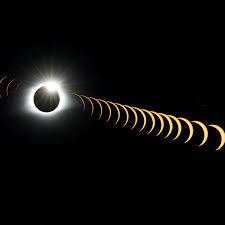
TOTAL SOLAR ECLIPSE
How much do you know about the solar eclipse?
How much do you know about the solar eclipse?
On April 8, a total solar eclipse will travel across the United States and be visible from parts of 13 states: Texas, Oklahoma, Arkansas, Missouri, Illinois, Kentucky, Indiana among others.

What you must know about it
1.The temperature will drop during a total eclipse
During a total eclipse, the temperature shifts dramatically. This shift will vary based on location, but it will drop about 10 degrees Fahrenheit on average.
2.Total eclipses are rare but not that rare
We think of total eclipses as rare but the occurrence of an eclipse isn’t actually that rare. A total eclipse occurs about once every 18 months. However, since Earth is 70% water, most eclipses occur over the open sea with very few people observing them.
3.Viewing an eclipse in the same location happens only once in lifetime
While a total eclipse is not rare, the opportunity to observe an eclipse from the same location is incredibly rare. A total solar eclipse takes about 375 years to happen again in the same location.
4.Wildlife will respond to the shifting light of an eclipse. As the partial eclipse progresses and the sky darkens, birds will begin their early evening routine of flocking/swarming and chirping loudly. As we plunge into the darkness of totality, birds will land and go quiet.
5.You’ll see Baily’s Beads moments before totality
In the seconds before totality occurs, it will seem like light is dancing on the sides of the moon. This phenomenon, known as Baily’s Beads, was named after a 19th century English astronomer, Francis Baily. It occurs when the moon’s craters and valleys break up the light.
6.Eclipses mean different things to different cultures. Different cultures have their interpretations of eclipses. In ancient China, dragons were said to be eating the sun. People would bang on drums to frighten the dragons away. In Navajo culture, eclipses are seen as a time for rebirth and quiet reflection.
7.Stars and planets will be visible. If you’re located in an area with little light pollution, you’ll be able to see some of the brightest stars, like Orion, and even a few planets — notably Jupiter and Venus.
8.Eventually Earth won’t have eclipses
This is a unique time in Earth’s history. The moon is moving about an inch away from the Earth each year. The distances between the Earth and the moon and the Earth and the sun make their sizes appear almost the same, allowing for the occurrence of total eclipses. Eventually, Earth will only get annular eclipses.
9.Just like tornado chasers, eclipse chasers also exist
Known as umbraphiles, which means shadow lovers, eclipse chasers are known to plan their world travels around pursuing eclipses. They use a variety of tools to observe eclipses in different ways and from various perspectives, such as from an airplane or in a forest.
END.